Body Care, Jams
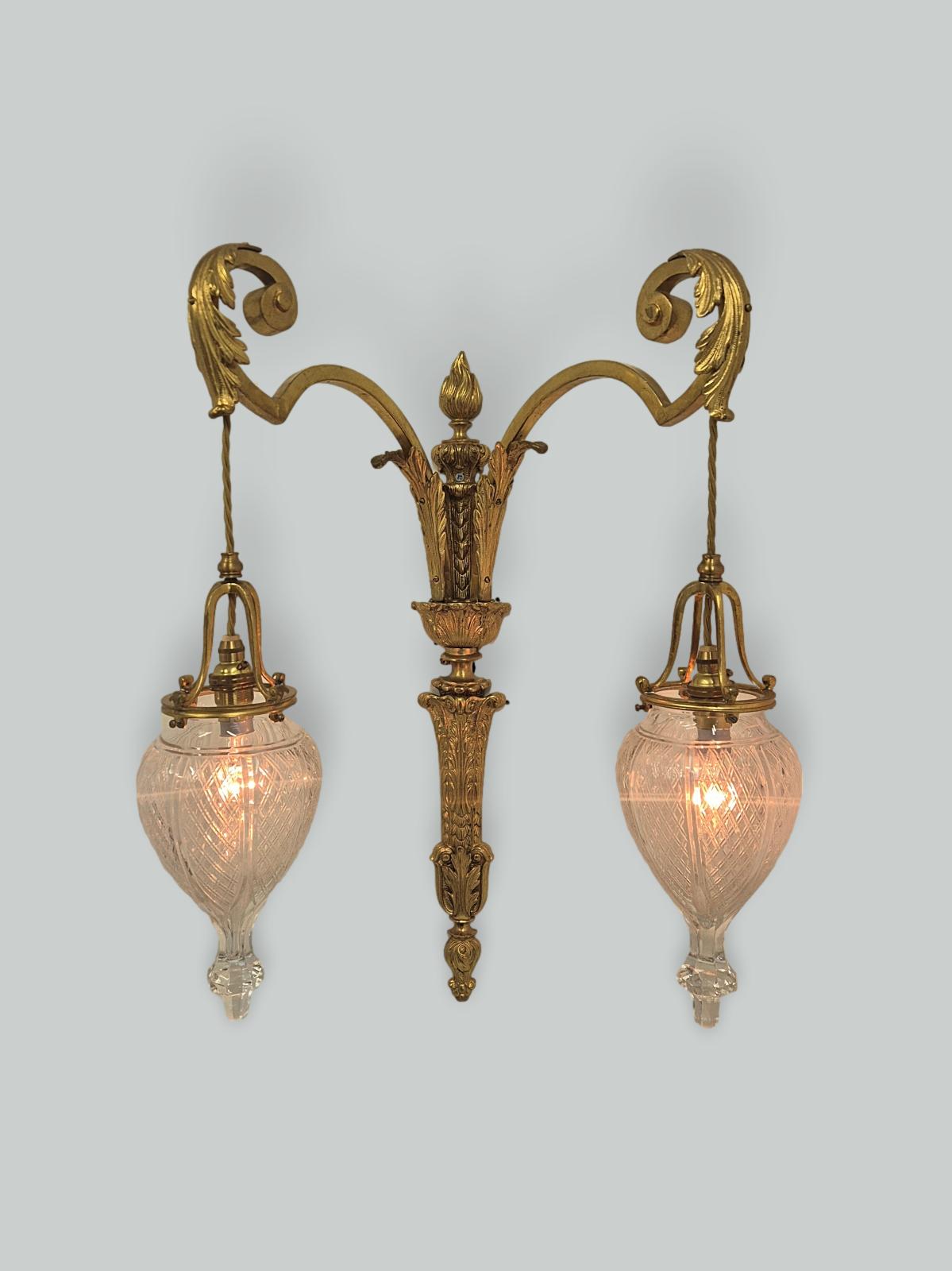
Attributed F & C Osler, Birmingham | 2 Monumental Louis XVI-st...
$ 91.92
Availability:
An exceptional pair of monumental Neoclassical Louis XVI style twin-arm wall lights (appliques), almost certainly manufactured by the premier British firm F. & C. Osler of Birmingham. This grand pair exhibits the symmetry, balanced proportions, and rigorous casting characteristic of fine late Victorian and Edwardian architectural lighting. Both brackets addorned with their original cut-glass knop lampshades pruduced certainly at Stourbridge glass works. England c.1900-10 Please Note: Price for the pair Not available to buy seperately Dimensions / Specifications: Ht.(overall)61cm/24in, Ht.(backplate)58/22.75, Dpth.25/10, W.44/17, Ht.(shade and gallery)32/12.5 Not Included: 4 x B.22 (4w or 6w) L.E.D golf/candle bulb (Available to purchase in our accessories department) Screw fixings F & C Osler, Birmingham (1807-1925) later Osler & Faraday Birmingham & London (1925-1965) The company Osler was established in Birmingham in 1807 by Thomas Osler They were the world’s preeminent makers of monumental crystal chandeliers and “exhibition pieces,” including a 4-tonne crystal fountain for the 1851 Great Exhibition. In the latter half of the 19th century Osler found success in India due to the countries wealth and efficient shipping links. The name F & C Osler was first recognised on 14th July 1906 when the children and grandchildren of Follett and Clarkson became the first directors. From 1911 the demand for simple clean pieces of glass was lost, however the demand for electric light fittings made from metal was flourishing. This coincided nicely with the opportunity to merge with the matalware company named Faraday & Son Ltd which began in1919. The 2 firms fully merged in 1925 to form Osler & Faraday Ltd, moving into their combined London headquarters “Lanthorne House” at 89–91 Newman Street. This was seen as a strategic union. F. & C. Osler(the glass masters) provided the financial backing and the manufacturing power in Birmingham, while Faraday & Son Ltd (the metalwork masters) provided the prestigious London connection and expertise in electrical engineering.